Golf club length explained: standard, long and short
Club length is the simplest fitting number and the easiest to get wrong. A club that is too long or too short by an inch changes your posture, your strike and your distance. This guide explains standard club lengths, how length is measured, and how to tell whether your clubs fit you.
Golf club length is the distance from the end of the grip to the sole of the clubhead, measured along the shaft. A standard 7 iron measures around 37 inches for men and 36 inches for women, and each club in the set gets about half an inch shorter as the loft goes up. Clubs that are too long force you to stand too upright and catch the ball thin or on the toe. Clubs that are too short force you to crouch and catch it heavy or on the heel. The right length lets you stand in a relaxed posture with the sole flat on the ground.
What club length is
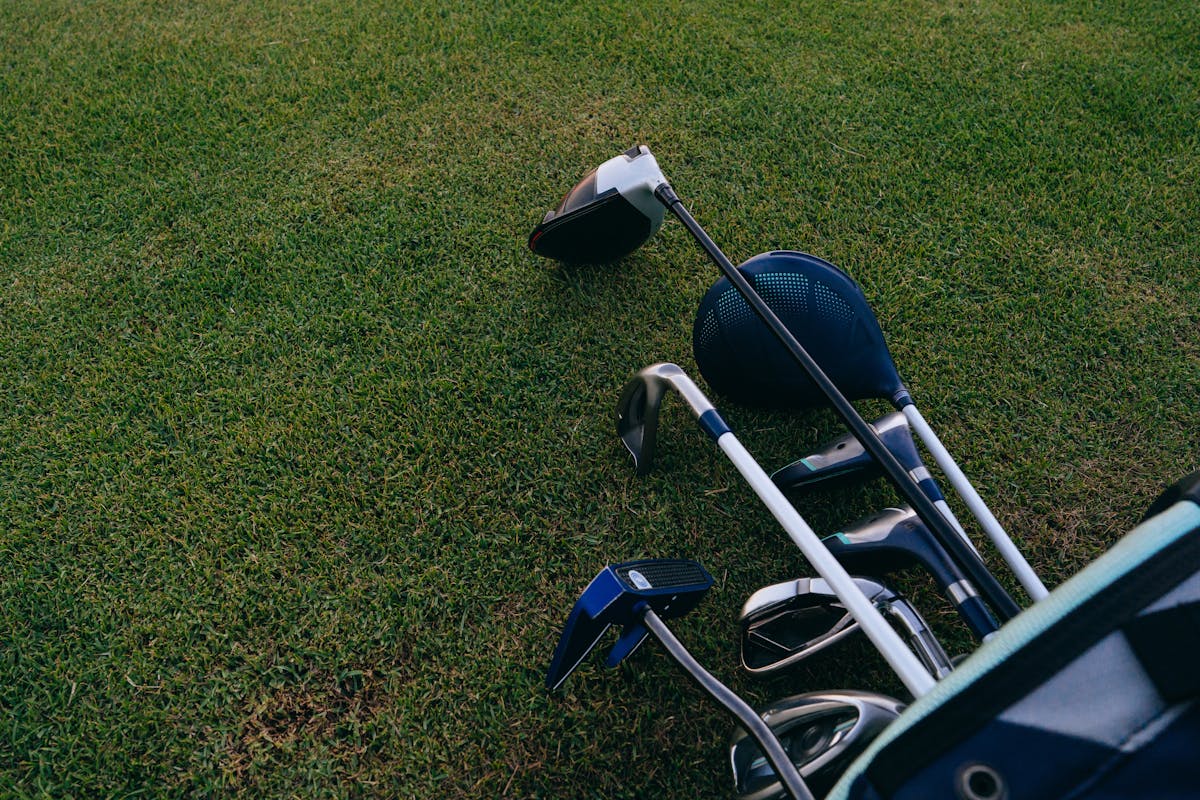
Club length is the distance from the butt end of the grip to the sole of the clubhead, measured along the back of the shaft. It is the longest dimension of the club, and it decides how far you stand from the ball. Every club in a set has a different length. Long clubs, like the driver, are built for speed. Short clubs, like the wedges, are built for control. The length of each club is set by the maker, and the standard lengths are close across brands but not identical. A 7 iron from one brand can be a quarter of an inch longer than a 7 iron from another. The standard is a starting point, not a rule. Your height, your arm length and your posture decide the length you need. See Clubface angle explained: open, closed and square at impact for the other fitting number that shapes your irons.
Standard club lengths by club
Standard lengths follow a simple pattern. The driver is the longest club in the bag, around 45 to 45.75 inches for men. A 3 wood sits near 43 inches, a hybrid near 40.5 inches, a 4 iron near 38.5 inches, a 7 iron near 37 inches, a 9 iron near 36 inches and a pitching wedge near 35.5 inches. Each step down the set is about half an inch shorter than the one before it. The pattern is the same for women, with every club about an inch shorter than the men's standard. These numbers are the industry standard, not a law. Brands set their own lengths, and modern drivers have crept longer over the years as makers chase clubhead speed. The important thing is not the number on its own. It is whether the length lets you stand in a relaxed posture with the sole flat on the ground. See Golf club distances: how far each club should go for what each club is expected to do once it fits.
How club length is measured
Length is measured with the club resting on a flat surface, sole down, with a ruler running along the back of the shaft from the ground to the end of the grip. The grip cap counts, so the measurement includes the full grip. Fitters use a measuring ruler with a stop at the bottom, which keeps the number consistent from club to club. The common shortcut is the wrist-to-floor measurement. You stand relaxed with your arms hanging, and the fitter measures from the crease of your wrist to the floor. A longer wrist-to-floor number means longer arms relative to your height, which usually points to longer clubs. The measurement is a starting point for a fitting, not a verdict on its own. Your posture at address matters as much as your arm length, and the fitter watches how you stand over the ball before they change anything. See Is club fitting worth it for a mid handicapper for when a fitting is worth the money.
What happens when clubs are too long
Clubs that are too long push you away from the ball. You stand too upright, your arms hang too far from your body, and the toe of the clubhead digs into the ground while the heel lifts. The strike moves toward the toe, the ball comes off thin, and the face tilts so the ball starts left for a right-handed golfer. Tall golfers are the usual victims, because standard clubs are built for average height, but anyone who stands close to the ball can have the same problem. The fix is not to choke down on the grip, though that helps for a shot or two. Choking down changes the swing weight and shortens the effective length in a way that is hard to repeat. The real fix is a shorter shaft, cut to fit your setup. See Golf posture and setup: the foundation checklist for the posture a fitted club should let you hold.
What happens when clubs are too short
Clubs that are too short pull you toward the ball. You crouch over the shot, your knees bend too much, and the heel of the clubhead digs in while the toe lifts. The strike moves toward the heel, the ball comes off heavy, and the face tilts so the ball starts right for a right-handed golfer. Short golfers and juniors who have outgrown a cut-down set are the usual cases. The swing also suffers, because a crouched posture limits your turn and forces your arms to lift the club instead of swinging it. The fix is a longer shaft, either an extension plug or a new shaft. A longer club is also heavier at the head, so the fitter may lighten the head to keep the swing weight where it was. See The 12 golf swing checkpoints, explained for the positions a crouched setup breaks first.
Length and lie angle
Length and lie work together, and changing one changes the other. A longer club plays flatter, because the shaft reaches further from your body and the sole sits at a shallower angle. A shorter club plays more upright, because the shaft stands closer to vertical. If you lengthen a club by an inch without changing the lie, the lie effectively gets flatter by about a degree. If you shorten it, the lie effectively gets more upright. That is why fitters adjust length and lie in the same session. A club can have the right length and the wrong lie, or the right lie and the wrong length, and either mistake moves the ball sideways. If your fitter changes your length, ask them to check the lie on the lie board at the same time. See Lie angle explained: how it changes your ball flight for the full lie story.
Length, distance and control
A longer shaft gives the clubhead more speed, and more speed means more distance. That is why drivers keep getting longer. But the gain is small and the cost is real. Half an inch of extra length is worth only a few yards, and it makes the club harder to square up. Most golfers hit a longer driver further on their best strikes and worse on their average ones, because the extra length moves the strike toward the toe and the heel. The same trade holds for irons. A longer iron goes a little further, but the gap between clubs stays the same, so you gain nothing in the set. You only gain a longer 7 iron that is harder to hit. The rule is simple: take the longest club you can hit from the middle of the face most of the time, not the longest club you can hit once. See Golf distance gaps: how to check yours for how to tell whether your set is gapped right.
How to check your club length
Three checks tell you whether your length is right. First, the address check. Set up to a ball with a 7 iron and look down at the clubhead. The sole should sit flat on the ground, with the shaft pointing roughly at your belt buckle. If the toe is clearly in the air, the club is too short for your setup. If the heel is in the air, it is too long. Second, the posture check. Stand in your address position and ask whether you feel relaxed. If you have to reach for the ball or crouch over it, the length is wrong. A good setup feels like standing over a ball that is already in the right place, not like reaching for one that is not. Third, the strike check. Hit ten balls off grass and look at where the ball marks sit on the face. Marks clustered on the toe point to clubs that are too long. Marks clustered on the heel point to clubs that are too short. If all three checks agree, book a fitting. If they disagree, the problem is probably in the swing, not the clubs. See The golf grip: neutral, strong and weak explained for the first check to rule out before you blame the clubs.
Cutting and extending clubs
Length is adjusted by a clubmaker, not at home. To shorten a club, the fitter cuts the shaft from the butt end, the grip end, and fits a new grip. To lengthen a club, the fitter glues an extension plug into the butt end of the shaft and fits a new grip over it. Both jobs are quick and cheap compared with new clubs. The catch is swing weight. Cutting a club makes it play lighter, and lengthening it makes it play heavier, because the head sits further from your hands. A good fitter adds lead tape to the head of a shortened club or removes weight from the head of a lengthened one to keep the swing weight right. Graphite shafts need more care than steel when they are cut or extended, and the work should be done by someone who has done it before. Second hand clubs are the best candidates for a length change. A used set was built for someone else, and a cut or an extension is often all it needs to fit you. See How to choose golf irons: a practical guide for what else to check when you buy a set.
Length for juniors, tall and short golfers
Length matters most at the extremes. Juniors grow fast, and a set that fits in spring can be too short by autumn. Junior sets are built in sizes by height, and the rule is to refit when the child grows about two inches. Do not hand a junior a cut-down adult set and leave it for years. The clubs will be too short, the child will crouch, and the crouch will become the swing. Tall golfers, over about 6 foot 2, usually need irons half an inch to an inch longer than standard, and short golfers, under about 5 foot 6, usually need them half an inch shorter. But height is only a rough guide. Arm length matters more than height, and two golfers of the same height can need different lengths. A tall golfer with long arms can play standard length, and a short golfer with short arms can need standard length too. The wrist-to-floor measurement catches this. Measure it before you buy, and let the fitting decide. See Junior golf: building a swing that lasts for how to keep a young golfer in clubs that fit.
What to practise this week
Take a 7 iron to the range and hit ten balls, then look at the face. If the marks sit on the toe, try choking down half an inch and hit ten more. If the marks move to the middle, your clubs may be too long. If the marks sit on the heel, try gripping the club at the very end and hit ten more. If the marks move to the middle, your clubs may be too short. Then set up to a ball and check the sole. It should sit flat on the ground with the shaft pointing at your belt buckle. If the flight, the face marks and the sole all point the same way, book a fitting and take your worst club with you. While you are there, film three swings from face on and check whether your posture stays relaxed through impact. If the fitting says the length is right, the miss is in the swing, and you have ruled out the clubs in one visit. See How to film your golf swing for the camera setup, and How to analyse your own golf swing video for the review routine.
Frequently asked questions
What is the standard length of a 7 iron?
A standard men's 7 iron measures around 37 inches, and a standard women's 7 iron measures around 36 inches. The exact number varies by brand and model. Each club in the set is about half an inch shorter than the one before it, so a 5 iron sits near 38 inches and a pitching wedge near 35.5 inches.
How do I know if my clubs are too long?
Stand in your normal address position and look at the clubhead. If the heel of the sole lifts off the ground while the toe touches down, the club is too long for your setup. On the course the signs are thin strikes, shots off the toe, and a ball flight that starts left for a right-handed golfer. A fitter can confirm it with a wrist-to-floor measurement in minutes.
Can golf clubs be shortened or lengthened?
Yes. A clubmaker can cut a steel shaft down from the butt end and fit a new grip, or add an extension plug to make it longer. Cutting a club makes it play lighter, and lengthening it makes it play heavier, so the fitter may add or remove head weight to keep the swing weight right. Most irons can be adjusted by half an inch to an inch either way.
Does club length affect distance?
Yes, but only a little. A longer shaft gives the clubhead more speed, so the ball goes further, but the extra length also makes the club harder to control. Half an inch of length is worth roughly a few yards. Most golfers lose more distance to off-centre strikes than they gain from a longer shaft, so control matters more than raw length.
Check your setup against your clubs
Your clubs can only do their job if they fit your body. Film your swing and see whether your setup puts the sole flat on the ground.
Download FormCaddie freeMore guides
- Lie angle explained: how it changes your ball flight
- Golf shaft flex explained: regular, stiff and everything between
- Iron lofts explained: why your 7 iron is not your dad's 7 iron
- Clubface angle explained: open, closed and square at impact
- Is club fitting worth it for a mid handicapper
- How to choose golf irons: a practical guide
- Golf club distances: how far each club should go
- Golf distance gaps: how to check yours