Indoor golf practice: getting better without a range
Winter, rain, or a busy schedule does not have to pause your progress. A garage, a net, and a mirror can carry your swing forward for months. Here is the indoor practice setup and the drills that actually transfer to the course.
Indoor golf practice works when you train what transfers: slow-motion swing reps, mirror-checked positions, short-game touch on a putting mat, and mobility for a fuller turn. A hitting net plus a mirror covers most of it. What does not transfer well is judging ball flight, so skip distance chasing indoors and train positions and contact instead.
The minimum home setup
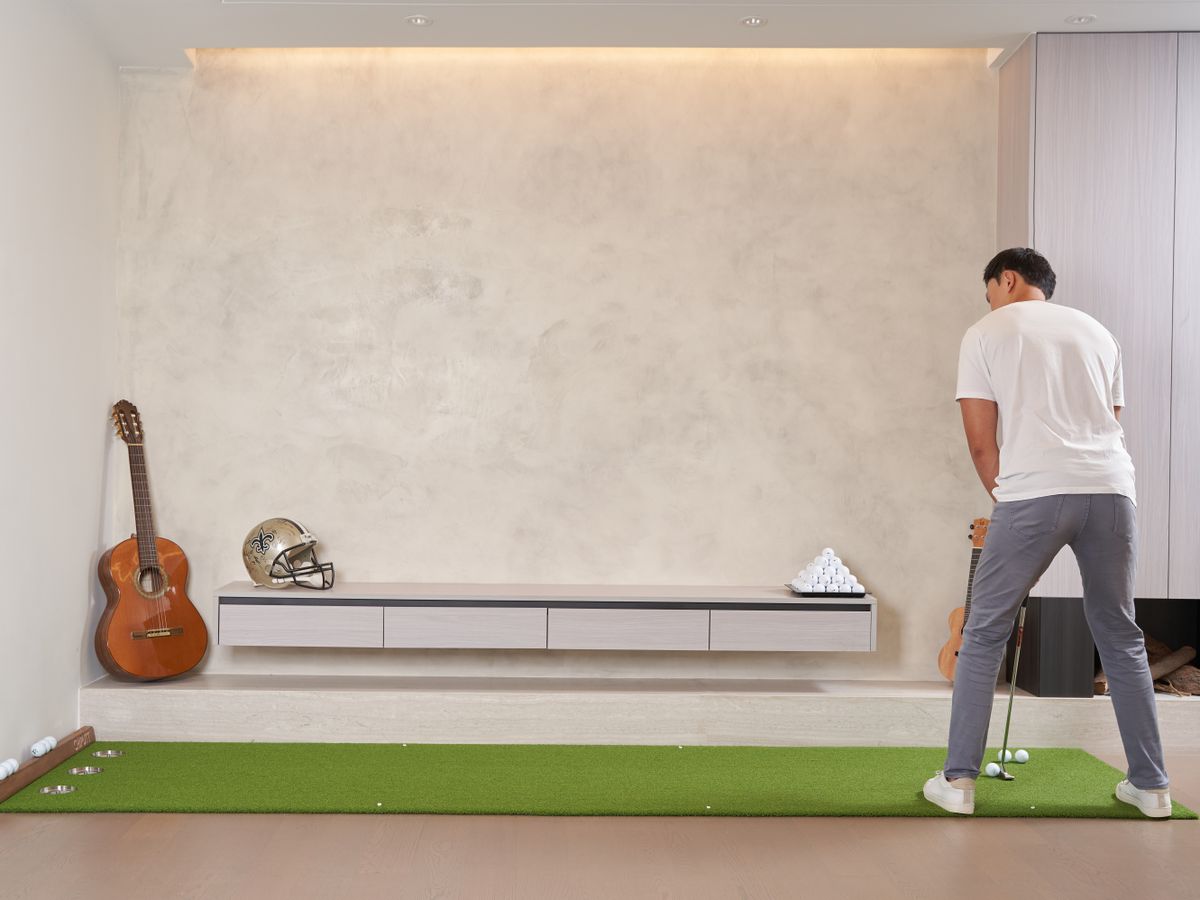
You need less than you think. A hitting net, a mat, and a full-length mirror cover 80 percent of indoor practice. Check your ceiling height with a slow practice swing first, driver needs about 9 feet, irons less. Foam balls are fine for contact drills and kind to drywall. Put the mat where you have room to swing a full 7-iron without fear, because a swing you are afraid to finish teaches nothing.
Slow-motion reps: the best indoor drill
Swing at 25 percent speed with no ball and stop at the top, at impact, and at the finish. At that speed you can feel every position, and you can repeat it 50 times without fatigue. This is how positions get built: slow, correct, repeated. Do 3 sets of 15 slow full swings, pausing two seconds at the top each time. It looks too easy to work. It is the single most effective drill you can do without a ball.
Mirror work for positions
A mirror gives you feedback a net cannot. Face-on, check your posture, grip, and that your head stays steady through the swing. Down-the-line, watch the club at the top and check your spine angle at impact. Pick one position per session and do 20 slow reps watching it. The mirror habit pairs well with a structured plan, see A range practice plan that actually improves your swing for how to organize sessions.
Hitting into a net
The net is for contact and rhythm, not distance. Alternate 10 balls at half speed focusing on the middle of the clubface, then 10 at full speed with a smooth tempo. Listen to the strike: a crisp click means centered contact, a dull thud means you missed the sweet spot. Foam or limited-flight balls still teach centered contact. One rule: never grind full-speed drivers into a net for an hour. That trains speed without feedback, which is how bad habits get fast.
The indoor putting station
A putting mat is the highest-value indoor purchase. Roll 25 putts from 3 feet, the goal is 25 in a row, and restart the count on a miss. Then the gate drill: two tees just wider than the putter head, 10 putts through the gate from 6 feet. Finish with pace: 10 putts from the far end of the mat, all stopping inside a three-foot zone. Twenty minutes, three times a week, and your stroke will be the best part of your game by spring.
Mobility for a fuller turn
Indoor months are the best time to fix the body, because the fix has months to settle before it matters. The two golf joints are the thoracic spine and the hips. Ten minutes daily: thoracic rotations on the floor, hip flexor stretches, and deep squat holds. The full routine is in Golf mobility: the t-spine and hip routine for a fuller turn. A fuller turn built in February shows up as free distance in May.
Film your swing indoors
Indoor filming is easy to get right with two tips. One, face the light: the camera should look at the lit side of you, not into a window. Two, use a plain background so the analysis can see your positions clearly. Film one swing at a time from face-on and down-the-line, just like outside. To understand what an app can actually read from the footage, read How do AI golf swing analyzers work?. FormCaddie films one swing on your iPhone, measures 12 checkpoints with Apple Vision and a club-tracking model, ranks the visible faults by impact, and gives one explanation and one drill from a library of 23. The video never leaves your phone.
A 30-minute indoor session
Here is a template you can repeat all winter. Minutes 0 to 5: mobility, t-spine and hips. Minutes 5 to 12: 30 slow-motion swings in the mirror, one position focus. Minutes 12 to 22: net work, alternating half-speed and full-speed sets of 10. Minutes 22 to 30: putting mat, the 3-foot drill and the gate drill. Film two swings at the end, one face-on and one down-the-line, and compare them to last week. Thirty focused minutes beats two unfocused hours.
What transfers to the course (and what does not)
Transfers: positions, tempo, centered contact, putting stroke, mobility, and your pre-shot routine. Does not transfer: judging ball flight, distance control on full shots, and reading real greens. So plan your first outdoor session as a translation week: half swings first, then work up, and expect your distances to feel unfamiliar for a round or two. The positions you built all winter are real. The feel for the course just needs one session to come back.
Keep improving at home
Film your swing at home and keep improving without a range.
Download FormCaddie freeMore guides
- The 12 golf swing checkpoints, explained
- How to film your golf swing
- Over the top: what causes it and how to fix it
- Early extension: why your hips move toward the ball
- What a golf swing analyzer app can and cannot measure
- The best golf swing analyzer apps in 2026
- How to fix a slice: causes, checks and drills
- Golf swing tempo: the 3-to-1 ratio explained
- How to stop topping the golf ball
- The golf grip: neutral, strong and weak explained
- Ball position in the golf swing: the full guide
- Casting in the golf swing: causes and fixes
- How to hit irons solid: compression explained
- Golf swing basics: the complete beginner guide
- Chicken wing in the golf swing: what it is and how to fix it
- Reverse pivot: the weight-shift fault and how to fix it
- Golf posture and setup: the foundation checklist
- Shallowing the club: what it means and how to do it
- How to break 90: a realistic plan
- Lag in the golf swing: what it is and how to build it
- Sway vs turn: lateral movement in the golf swing
- How to aim in golf: alignment that actually works
- How to stop hitting behind the ball (fat shots)
- Wedge distance control: the clock system
- Do AI golf swing analyzers work?
- How do AI golf swing analyzers work?
- AI golf swing analyzer vs golf lessons
- Are golf swing analyzer apps accurate?
- Free AI golf swing analyzer: what you actually get
- A range practice plan that actually improves your swing
- The pre-shot routine: build one in 20 seconds
- Hip rotation in the golf swing: how much and when
- Weight transfer in the golf swing: the pressure story
- Golf swing myths worth dropping
- Swing plane explained: what it is and how to check yours
- Face-on vs down-the-line: which camera angle shows what
- What your divots tell you about your swing
- Chipping technique: the simple motion that saves shots
- Golf mobility: the t-spine and hip routine for a fuller turn
- The mental game: playing golf without sabotaging yourself
- Course management: scoring without a better swing
- Junior golf: building a swing that lasts
- How to break 80: the next level plan
- Golf swing for seniors: keeping distance after 60
- How to hit a draw: the simple way
- Bunker shots: the splash technique that gets you out
- The downswing sequence: what moves first
- The backswing: the positions that matter
- Impact position: what it looks like and how to get there
- How to stop hitting it thin
- The shanks: what causes them and how to fix them
- Golf club distances: how far each club should go
- Golf handicap explained: what your number means
- Golf grip pressure: how tight should you hold the club
- Golf stance: how wide to stand and why it matters
- Releasing the club: what release means and how to do it
- Wrist hinge in the golf swing: when and how much
- Inside takeaway: the first-move fault and how to fix it
- How to hit a fade (without slicing it)
- How to hit a hybrid: the sweeping strike that launches it
- The punch shot: low flight for wind and tree trouble
- The flop shot: when to hit it and how to commit
- Wedge bounce explained: what it is and how to use it
- How to hit irons higher (and when to flight them down)
- The finish position: what a balanced finish tells you
- Ball flight laws: what actually controls direction and curve
- How to break 100: the beginner scoring plan
- What is a good golf score for a beginner
- How long does it take to get good at golf
- Golf etiquette: the unwritten rules every beginner should know
- Golf terms explained: the words you hear on the course
- Playing golf in the wind: flight, club and aim adjustments
- Is club fitting worth it for a mid handicapper